CAPERNAUM,
Israel -
"Archaeological, historical and literary evidence all point to the same
conclusion: this first century structure was the home of one of Jesus'
closest companions and disciples, Simon Peter," said the well known
archaeologist, Prof. Vasillios
Tsaferis, while pointing to a series of buildings uncovered at the
ancient city of Capernaum.
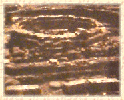
A close-up view of the first century remains of the home of the Disciples Peter and Andrew. Here, Jesus healed Peter's mother-in-law (Mark 1:29-34), cured a paralytic who was lowered from the roof (Mark 2:1-4), and preached to the multitudes. (Matt. 12:46-50)
During an exclusive interview with the Jerusalem Christian Review, Tsaferis, who serves as the Director of Excavation Services for the Israel Government Antiquities Authority, which supervises all archaeological work in Israel, explained that, "the excavation team discovered remarkable evidence, including inscriptions, which indicate that this place was indeed the site of some of the most significant events recorded in the Gospel accounts."
On the northeastern shores of the Sea of Galilee, first century Capernaum was the center of Jesus' ministry. It had a uniquely cosmopolitan flavor because it was located on the border between the two kingdoms of Herod's sons, Herod Antipas and Herod Philip.
As a border town, it controlled a major highway which brought in people from many walks of life. Capernaum also boasted a customs depot and a Roman military garrison.
"The home of Peter, and his brother Andrew, was also Jesus' residence for much of the two years of His ministry around the Sea of Galilee," says Tsaferis, who is one of the world's leading experts on Galilean archaeology.
There He healed Peter's mother-in-law (Mark 1:29-34), cured a paralytic who was lowered from the roof (Mark 2:1-4), and preached to the multitudes. (Matt. 12:46-50)
Several ancient Greek and Hebrew inscriptions were uncovered inside the first century structure. The name "Peter", scratched on the wall, was found along with an inscribed prayer addressed to, "Jesus Christ, the redeemer [or helper]."
Another invocation, most of which was not preserved, was part of an ancient memorial at the site. The words which could be deciphered read: "The Lord, Jesus... have mercy... Amen."
The first century building discovered at Capernaum consists of a large, circular cluster of rooms around a spacious courtyard.
The house is located only 100 feet (30 meters) south of the city's synagogue on the large, main street of the town. An open area between the street and the doorway, leading to the courtyard, makes the building unique among others found in the vicinity. This open area would have allowed space for a large number of people to "gather at the door" of Peter's home to hear Jesus' preaching. (Mark 1:33; 2:1-3)
Parts of the structure and walls of the home were preserved, including a stairway, fireplace and multiple rooms, some with first century mosaics.
Inside the building, numerous coins, pottery and oil-lamps dating to the first century were discovered, along with artifacts which included several fish hooks.
Archaeologists also unearthed evidence of memorials built by later Christian generations around Peter's home.
"Christians who lived in Capernaum during the second, third and fourth centuries highly venerated this site and showed great care not to destroy the house, but rather to add additional structures to it," said Italian scholar, Virgilio Corbo, who excavated at the site.
By the fourth century A.D., Christian historians already noted that the site of Peter's home had become the focal-point for Christian worship in the Galilee.
An abundance of archaeological evidence, including elaborate building structures and over one-hundred inscribed supplications and decorations dating to the third and fourth centuries were discovered above and astride the first century remains.
This worship continued until the seventh century A.D., when Capernaum was conquered and destroyed by invading Moslem forces. Since then, it was buried under centuries of rubble, only to be unearthed by modern archaeologists today.
"The early Christians recognized that Peter's home was not just an obscure structure," says Prof. Tsaferis. "From the evidence which was left behind, they believed this house was a location of immense significance... a site which was, after all, the physical dwelling-place of the Lord Himself."
Uncovered from centuries of rubble, pilgrims may again view the remains of the home of the Disciple, Simon Peter, son of Jonah, along with other first century ruins of Capernaum.
Copyright © 1998 Jerusalem Christian Review. All rights reserved.
This article was reprinted with permission from the Jerusalem Christian Review, Volume 9, Internet Edition,
Issue 1.
For more information, please see the Jerusalem Christian Review site.