Copyright © 1998 John D. Beckett, Loving Monday: 70-75.
THE JEWISH TALMUD tells a story of an elderly rabbi's counsel to his young nephew. The boy already knew the Torah, the Old Testament Law. Now he wanted to study the wisdom of the Greeks.
The rabbi recalled God's words to Joshua: "You shall meditate on it [biblical law] day and night."
"Go, then," said the rabbi. "Find a time that is neither day nor night, and learn then Greek wisdom."
Like that rabbi, who put little stock in the value of studying Greek philosophy, Tertullian, an early Christian theologian, wrestled with the conflict in his day between Greek and Hebrew thought. He asked: "What has Athens to do with Jerusalem?" (Christian Overman, Assumptions That Affect Our Lives).
What was so different? Basically, the sources were different. The Hebrews depended primarily on revelation, inspired directly by God. The Greeks, who didn't acknowledge the one true God, depended on humanly inspired reason.
Because the sources were different, the results were different. Different views of deity, of origins, of absolutes, of truth resulted in different worldviews.
Abraham Kuyper, a dynamic Christian thinker who became prime minister of the Netherlands in the early 1900s, addressed the students of Princeton Theological Seminary in 1898. He said this concerning worldview:
As truly as every plant has a root, so does a principle hide under every manifestation of life. These principles are interconnected and have their common root in a fundamental principle; and from the latter is developed logically and systematically the whole complex of ruling ideas and conceptions that go to make up our life and worldview. (Abraham Kuyper, Christianity: A Total World and Life System)
A. W. Tozer, in The Pursuit of God, describes the result of the shift in views this way:
One of the greatest hindrances to the Christian's internal peace is the common habit of dividing our lives into two areas—the sacred and the secular. But this state of affairs is wholly unnecessary. We have gotten ourselves on the horns of a dilemma, but the dilemma is not real. It is a creature of misunderstanding. The sacred-secular antithesis has no foundation in the New Testament.
Biblical thought is not dualistic. There is no "higher" and "lower." The psalmist said, "The earth is the LORD's, and all its fullness." True, in the Old Testament there were distinctions between sacred and secular, but even these temporary distinctions were abolished in New Testament Christianity.
How we view our work, then, is profoundly influenced by the worldview we choose—the Greek model or the biblical (Judeo-Christian) model.
Larry Peabody focuses on this issue in Secular Work Is Full-Time Service, the most helpful book on a biblical view of our work I have ever read:
In the New Testament God does not depict the Christian life as divided into sacred and secular parts. Rather, he shows it as a unified life, one of wholeness, in which we may single-mindedly serve him, even in our everyday work. The glorious, liberating truth is that in Christ, God has performed the impossible. In Christ, that which was once secular has become sacred. The wall between them has been removed. `For everything created by God is good, and nothing is to be rejected, if it is received with gratitude: for it is sanctified by means of the word of God and prayer' (1 Timothy 4:4-5).
Christian Overman depicts the contrast between Greek thought and biblical thought with two diagrams in his excellent book Assumptions That Affect Our Lives. I'm grateful for his permission to reproduce them here.
Figure 1 illustrates what we covered in the previous chapter, the widely held dichotomy between two realms—the higher, which is sacred, and the lower, which is secular. This is the worldview of the Greeks:
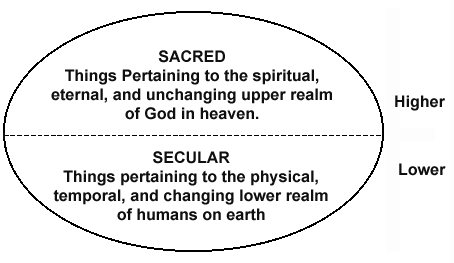
Figure 1. Greek Worldview (Dualism)
As noted previously, in the Greek view businesses and occupations inevitably end up in the lower realm.
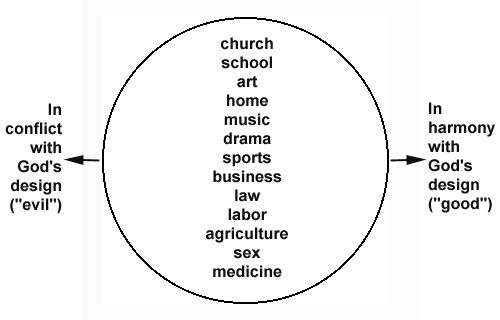
In contrast, the worldview depicted by the Bible holds that all things are good when in harmony with God's design, or evil when in conflict.
Figure 2. Biblical Worldview
In figure 2 is a list of various vocations and activities, but without regard to rank or worthiness. The distinctions between secular and sacred, higher and lower, don't exist. Overman says God's intent is that "every aspect of human existence and each divinely sanctioned institution is equally obligated to function in harmony with God's will, not in opposition to it."
Any of these endeavors can be in harmony with God's design—or in conflict. Take art, for example. Choices made by the artist will determine whether a painting or sculpture draws the observer toward that which is noble and good or toward that which is base, ignoble and evil. Our homes, our work, medicine, sports—even sex—can be in harmony with God's will or contrary to it. So the deciding factor is not a matter of higher or lower, or sacred or secular, but whether it is in harmony with God's will.
When I saw this distinction—this contrast in worldviews—I wanted to do cartwheels. If I hadn't grown up as a proper Episcopalian, I probably would have! I realized how much my thinking had been negatively affected by Greek dualism.
In stark contrast to my prior thinking, the Bible enabled me to view my work as having great worth to God, provided I would bring it into harmony with him in every way possible. As a believer and a business person, I was no longer a second-class citizen. Nor did I need to leave my Christian convictions and biblical values outside the office entrance when I headed into work on Monday mornings.
A biblical worldview has awesome implications for those of us in the secular, Greek-thinking West. As we allow it, the Bible speaks to us concerning government, economics, education, science, art, communications and, yes, business. Really, it speaks to all of life.