We'll interject at this point and switch things over to the second part of this segment. Dr. Bradley will now have an opportunity to address questions to Dr. Craig.
Dr. Bradley:
Well, it's obviously going to be my point to continue the little discussion we've had. You're saying, in effect, that when I characterize heaven as a possible world in which everybody freely receives Christ, I'm wrong insofar as that had to be preceded by this actual world, this world of vale of tears and woe in which people are sinful and the like.
Dr. Craig:
I'm saying that it may not be feasible for God to actualize heaven in isolation from such an antecedent world.
Dr. Bradley:
Well, you have got to provide grounds, then, for saying that there are logical connections as opposed to merely contingent ones between various stages of the actual world. And that would be a very difficult thing to try to prove.
Dr. Craig:
I don't think that I have to do that because . . . these statements about what creatures would freely do under different circumstances are contingent. They're not necessary truths. And it may just be the case that if God tried to actualize a world in which, say, everybody is just in heaven, some people would go wrong, and then He wouldn't be able to do it. And that's just a contingent fact that is the case.
Dr. Bradley:
I'll return to this microphone, if I may, okay? Now let me try to get my point across on this because this is crucial. And we both agree that Dr. Craig's strategy has been to try to prove that propositions (1) and (2) are compatible on the grounds that there is a third proposition which is consistent with (1) and with together with (1) implies (3). I've said that (3) . . .
Dr. Craig:
Entails (2).
Dr. Bradley:
Entails (2). Sorry! I've said that his (3) is all by itself inconsistent with (1).
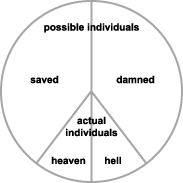
Let's look at it like this [draws circle on the overhead]. Let that circle represent the set of all possible persons that God could have created with free will and of whom He knows in advance from the very beginning, in the words of the Bible, what the outcome of their choices would be. Okay? Now that set of possible persons, possibilia as you call them in one of your works, can be subdivided more or less arbitrarily, we'll say, into those who would be saved if He were to create them and those who would be damned as a consequence of their free choices [divides the circle into two halves labeled "sacred" and "damned" respectively]. All right?
Dr. Craig:
I don't want to be difficult, but I think that's too simplistic because some people might be damned if created in some circumstances but saved if they were created in other circumstances. So you can't just divide the line down the middle and put people on either half. It depends on what world these possible persons are put into.
Dr. Bradley:
So we can shift the line wherever you wish according to which actual world God chooses to create. All right?
Dr. Craig:
All right.
Dr. Bradley:
Now He creates an actual world [designates a segment of the circle overlapping both halves]. These are just possible individuals up here, the whole domain of possible individuals with free will [designates individuals outside the segment]. Here we've got the actual ones [designates individuals in the segment]. And, as you can see, some of them on this have been assigned to heaven because God knew in advance that if He were to create them in these circumstances, they would be saved. And, here we have those He's consigned to hell. In fact, I've been generous to God and you here because I've created equal parts. And, of course, Jesus says its going to be pretty rough on most of them.
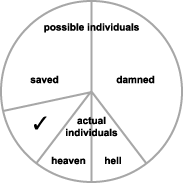
Now the point is this. Why did God have to create just this subset of possible individuals with free will? [designates segment of actual individuals] He could have sliced the pie a very different way. He could have sliced the pie so that there weren't any in this segment at all, the segment of hell [shades sub-segment of actual, damned individuals]. He could have chosen to create a world in which no actual individuals like you or me were existent [draws another segment outside the segment of actual individuals].
Dr. Craig:
Right.
Dr. Bradley:
After all, there's nothing all that great about us, is there?
Dr. Craig:
Right.
Dr. Bradley:
So He could have created all these possible individuals . . . [ticks new segment]
Dr. Craig:
And my point is He wouldn't be able to guarantee--so long as those people have free will--that they would FREELY RESPOND TO HIS OFFER OF SALVATION AND BE SAVED.
Dr. Bradley:
But if He knows in advance that these will in those circumstances be saved by virtue of freely accepting God's offer of salvation through the blood of Jesus, then why not?
Dr. Craig:
Because there may not be a compossible set of individuals such that if you put all of them together in a world, all of them freely receive God's salvation and are saved. It may be that individual "S" would only be saved in a world if in that world individual "S'" were lost . . .
So that it's impossible for God to . . . or infeasible for God to create a world in which all are saved . . . .
Dr. Bradley:
I understand quite well about them having to be compossible. And, let's just say that out of the set of all possible inhabitants of this world that God is going to choose to create, only some are compossible. So let's make it a subset. We now have a subset of compossible individuals all of whom would be saved.
Dr. Craig:
But, see, my point is that you don't know that such a set is not the empty set. It could be the empty set.
Dr. Bradley:
Well, look, you play with possibilities. You talk about it's possible that this, it's possible that that. . . I'm asking you to confront some actual examples of possibilities. Heaven is allegedly a state of affairs in which God exists and the only other persons to exist are people who either have been saved because they believed in Jesus' name or would have believed in Jesus' name and have been saved or you could throw in a few of those who get there by general revelation.
Dr. Craig:
But that in itself presupposes there was an antecedent pre-mortem world . . .
Dr. Bradley:
It doesn't logically presuppose it. Causally perhaps. But you understand the distinction between causal ties and logical ones as well as I do. [long pause]
Dr. Craig:
You've still got three minutes.
Dr. Bradley:
Oh, there's so much here! What I've just been doing, of course, is to go over some of the steps that I made in refuting the free-will defense Dr. Craig has employed. We haven't yet discussed the counter-arguments which I produced--or rather, if you like, the counter-thrusts that I made where I employed that broadly logical, or as I called it, logical semantical principle about the use of descriptive expressions. And I produced a set of subsidiary theses, all of which follow from that, which together with (1) imply the falsity of (2). I'll remind you of those if you wish. But I'd like you to say something about them because I think you are going to have some problems in trying to reject all or even, for that matter, any of the subsidiary . . .
Dr. Craig:
Yeah, I reject both P as well as P1 to 5. I think that P isn't even true.
Dr. Bradley:
Maybe you'd like to tell me why?
Dr. Craig:
Well, look at what P says. I'll read it for those who cannot see the overhead. "In order for a descriptive concept to have any significant application there must be some possible circumstances in which it doesn't apply." Now that doesn't seem to me to be true at all. What that entails . . . P seems to me to entail that there are no logically necessary truths. For example, the description of the properties of a Euclidean right triangle on a planar surface: there are no possible circumstances under which that description doesn't apply, and yet it clearly has a significant application. Or God; I would say that God exists in all possible worlds and has certain descriptive attributes essentially, and those are meaningful.
Dr. Bradley:
You're missing the point. I'm not stating that with respect to propositions, of course. I would not, since, as you know, I am as fervent a proponent of necessary truths as anyone. Rather I'm talking about concepts. I'm saying that in order significantly to say of somebody that they are good, for example, we've got to understand what it would be like for them not to be good. You can't stretch the term "good" so as to encompass all those possible circumstances in which one would naturally call a person "not good" or "evil." That's a point that was made by Aristotle.