"And Praised be thou, O Lord, forever, which dost likewise give us thy works and word for a pattern, whereby to erect this Pansophy, or temple of Wisdom: that as thy word and works are true and lively representations of thee: so this, which we are about, may prove a true, and lively image of thy word and works."
John Amos Comenius, A Reformation of Schooles, 24.
Mark Noll has said that the scandal of the evangelical mind is that there is none. Perhaps an even greater scandal is that a widespread flowering of the Christian mind was well under way in the seventeenth and eighteenth centuries, but has since been largely forgotten. Evangelicals often pine over the synthetic intellectual genius of Jonathan Edwards, but—beyond his puritan faith and his background in the Enlightenment—few evangelicals have any idea of the intellectual foundations on which his comprehensive approach to theology, philosophy and science rested. We have so neglected our minds that we have lost our own philosophical history.
In light of the current emaciation of Christian thought, is it really surprising that the modern academy views the believing scholar as a freak specimen? How can Christian scholarship be taken seriously when it presents itself as just a lens, without an identifiable paradigm. The Christian perspective is not perceived as an intellectually serious alternative because it lacks an organizing framework, a comprehensive methodology. As a result, it is dismissed as a merely distorting bias.
While Christian scholars have made headway in the academy, there still is no such thing as a discipline of Christian scholarship. Granted, there has been much discussion about the history of anti-religious discrimination within the university. Resources have even been developed to educate Christians in academia concerning their academic freedom in the classroom. Increasing numbers of scholars are being emboldened to speak out about their faith. In a few fields, such as philosophy, Christian scholars have even begun to earn a hearing by relating the perspective of their faith to certain specific points of their respective disciplines. Most of these efforts, however, tend to be apologetic in character. It is one thing to show that the post-modern mind is intellectually untenable. It is yet another thing to produce is a viable alternative. So far Christian scholarship have failed in this crucial constructive task.
There is no identifiable body of thought which articulates in an intellectual and practical way the Christian view of the integrality of all of knowledge, all of learning and all of life. Think of the next lecture on which you are developing or the article you are in the middle of writing. In that project, what methodology are you using to articulate the linkage between your personal devotion and that piece of work? Furthermore, how would explain the relationship of your current specialized focus of scholarship to that of your colleagues on the other side of campus and to the larger enterprise of truth as a whole? These are the crucial unanswered questions facing Christians scholars today. While this conference has offered a some general guidelines and a few philosophical perspectives, the point is that there is no paradigm or methodology of Christian scholarship.
The Puritans, our intellectual ancestors, on the other hand, were galvanized by the intellectual vision of Veritas: all the arts and sciences—revealed theology included—synthesized into a comprehensive view of truth based on "encyclopedia," the circle of knowledge with the intended result being "eupraxia," the practice of right living.{1} This vision was implemented in their scholarship through a methodology of meta-disciplinary intellectual integration which they called Technologia. Christian scholarship today lacks the cosmic scope of the Puritan mind, because it does not have an intellectual technology of synthesis and application. The thrust of this presentation is that Christian scholarship needs to visualize and begin to develop a similar vision and method for the integration of all knowledge. In order for the faith informed perspective to gain and maintain a significant place in the academy, we believing scholars need to reinvent a technology of intellectual integration. In order to illustrate what such a philosophical framework might look like, the first portion of this paper examine the historical case study of the Puritan mind. It will explain the Puritan method of technologia, recount the story of the historical movement of "Integrationism" that produced it, and will illustrate the Veritas vision under which this school of thought was originally embodied in American higher education. The second half will draw from this case study suggested parameters for the development of a similar intellectual infrastructure for Christian scholarship today.
What was "technologia"? By "technologia," the Puritans did not mean "technology" as we do. Technology to us usually means "applied technique." In their usage, technologia was a Latin transliteration of a word borrowed from Greek. It was a compound of techno meaning "skill" or "art" and logia meaning "the study of." Technologia was also known as "technometry," " the measure of a skill or art." By either word technologia or technometry,, therefore, they meant the study of the theory of the interrelation of the arts and sciences. If you will pardon the play on words, their technologia was what might today be called a technology of intellectual integration, that is an applied technique of relating all knowledge and its right use in life.{2}
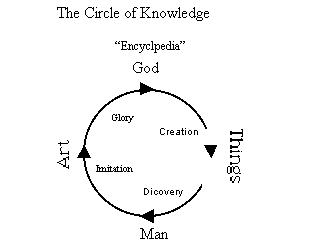
Technologia was the philosophical core of new England mind, through which the American Puritans sought to understand the relationship between God, the arts, and the scholar. See figure no. 1. It was a philosophy of the encyclopedic integration of the arts based on the concept of the circle of knowledge. On one level, encyclopedia was a circle between the subject of study, the person studying it, and the original divine Creator of the subject matter. The master design of God's mind, via creation, came to be represented in the things of the material natural world. Through scholarship, humankind discovers God's design and forms this knowledge into an imitation of God's design in the disciplines of the arts and sciences.
Figure No. 1
On another level, technologia was the skill of harmonizing all of these resulting academic disciplines in a circle of knowledge, called "encyclopedia." See figure no. 2. William Ames (1576-1633), one of the American Puritans favorite theologians, defined technologia as "the precognition of all the arts which adequately circumscribes the boundaries and ends of all the arts and of every art." Put simply, technologia was a synoptic correlation of the disciplines of the arts and sciences. Ames explained this circle of knowledge when he wrote, "The comprehension of all those arts by which things emanate from the Ens Primum [First Being] and return again to him is called Encyclopedia, whose first link of the circular chain is logic and the last theology." The Integrationists varied in the number of arts in their configurations. For example, Ames departed from the classical arrangement of seven arts, instead positing six: logic, grammar, rhetoric, mathematics, physics, and lastly, theology.{3} All of the Integrationists, however, built their configurations on to the same basic metaphor of encyclopedia.
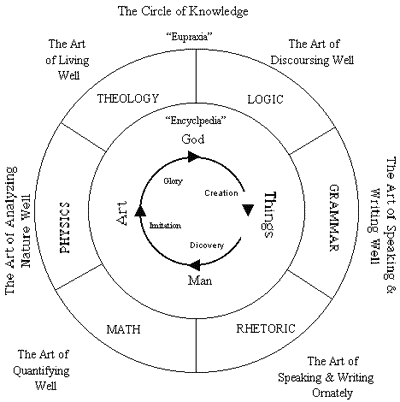
Figure No. 2.
The circular scheme of technologia did not end with the arts alone, but also extended to a third level, namely the uses of the arts in human vocations. Each discipline of knowledge was defined in terms of its use: logic as the art of discoursing well, grammar as the art of speaking and writing well, rhetoric as the art of speaking and writing ornately, mathematics as the art of quantifying well, physics as the art of analyzing nature well, and theology as the art of living well.
The emphasis on use fit in nicely with the practicality of the Puritan mind, providing a philosophical foundation for the working vocations. While scholarship discovers the divine pattern of creation and inscripted it in the academic disciplines, scholarship itself is only one of the many vocations. Each vocation is a faculty or applied use of one or more of these disciplines. Because humankind was created in the image of the Divine Artist, the vocations allow the human being to participate in the ongoing divine master plan of creation. Vocation functions spiritually as a kind of performance art—a participation in God's ongoing mission for creation. The human being as an artisan can follow in the footsteps of the Divine Artist. Through this circular pattern of the created order, humanity can fulfill its cultural mandate (Gen. 1:26-28) and returns glory back to God.
One of the main the texts from which the Puritans studied this grand scheme was Ames' Technometria. In Technometria Ames not only defines this encyclopedic systematization of the arts, but he also illustrates the application of art in an encyclopedic array of vocations—everything from fish farming to cryptography. Technologia was, therefore, a comprehensive integrated approach to all thought and life. It was a doxological approach to not only scholarship and its resulting academic disciplines, but also to the application of knowledge in vocation as well. It was a devotional method that made every thought and act of life into an act of piety. That is why Perry Miller, the great historian of Puritanism, described technologia as "the philosophical apparatus for the unification of Puritanism and logic, systematized by Ames, taught at Harvard, defended in theses, and expounded in all sermons along with theology, even as part of the theology—this is the metaphysic of Puritanism and the chief tie between its piety and its intellect."
As Miller intimated, technologia was historically significant because it provided the core curriculum of early Harvard and Yale into the eighteenth century. Besides Ames' Technometry, students during this period would study the precepts of technologia from Alexander Richardson's Logicians schoolmaster, John Alsted's Encyclopaedia, and John Comenius' Physicae ad Lumen Divinum Reformatae Synopsis.{4} They were taught technologia in class. They copied its method in student synopses. They memorized its theses and had disputations on them six days a week.
These Integrationist principles were even used by Harvard and Yale as a standard for graduation as well. Each year before commencement, a list of propositions called "theses" were selected from the various subjects of study and posted for each graduating class. For example, Jonathan Edwards' baccalaureate commencement from Yale in 1720 included these from the examination categories of technologia, logic, grammar, rhetoric, mathematics, and physics. While all students were responsible for being able to defend all the theses posted for a given year, individual students were assigned one or more specific theses to defend before the commencement audience. The thesis category of Theses Technologicae first appeared on the bulletin for Harvard's commencement on August 9, 1653. Theses Technologicae continued as part of commencements at Harvard until 1791 and at Yale until 1795.{5} The technological theses derived from these sources were the propositions laying out the precepts of the Integrationist method of synthesizing the truth from the various arts. Following the conviction that the integration of knowledge was a prerequisite to all learning, Technologia was the first category of theses in the commencement program. Edwards' graduation examination, therefore, began at the broadest integrative level with a technological thesis that stated, "Technologia is the ideal of being able to grasp as a whole the arts and sciences in general."{6} This vision and skill f intellectual integration provided the foundation on which Edwards built his synthesis of theology, science, and philosophy.{7}
This technologia of the New England mind was not a provincial anomaly, but was the product of a larger movement of the early modern era which I call the Integrationist movement. See figure no. 3. Throughout history many philosophers and thinkers have attempted to integrate the knowledge of reason and revelation with differing approaches and varied results. Indeed the tension of faith and reason could be said to be a driving force in most philosophy of the seventeenth and eighteenth centuries. The integrationist thinkers were unique, however, because they sought to synthesize these two sources of knowledge into unified systems using an encyclopedic approach that maintained the authoritative integrity of both. Their backgrounds had three common influences: a Christian view of truth; the visual logic of Ramism; and the "New Learning" of the Renaissance, early science, and the Enlightenment. Most significantly, these three factors converged as catalysts to the formation of the distinctly grand vision of Veritas, the discovery and integration of all truth. Because the impulse to integrate both Christian thought and life was central to all these thinkers, I term this movement "Integrationism." The Integrationist movement began in England with the work of Alexander Richardson (fl. 1629) and William Ames, and on the Continent through that of John Alsted(1588-1638) and John Comenius (1592-1670).
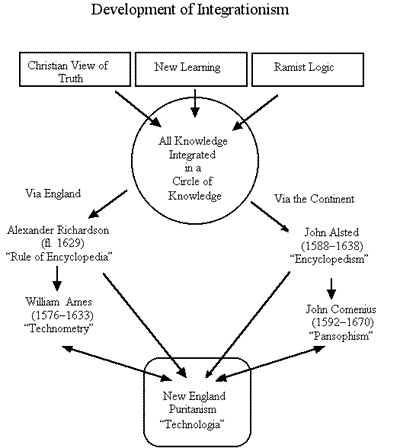
Figure No. 3
The first common aspect of the background of these Integrationist thinkers was the Christian conviction of the consistency of all truth. The Reformers had held to a traditional Christian conviction that there was one God and the world was created by his design. All truth was, therefore, God's truth. The Integrationists, however, went beyond the thought of the Reformers. Because Luther and Calvin first focused on recapturing the truth of the special revelation found in Scripture, they never fully worked out the implication of this doctrine of truth in relation to the general revelation found in nature. As a result they were inconsistent in relating the unity of truth to their views of reason and philosophy. This issue was only addressed later by Post-Reformation thinkers. While Calvin systematized theology, these thinkers sought to develop comprehensive systems of all Christian knowledge. This was the essence of Alsted's Encyclopaedia, Comenius' Pansophism, Richardson's "rule of encyclopedia," Ames' Technometry, and Edwards' "Rational Account." These thinkers remained convinced of their faith. Nevertheless, with the Christian conviction of the unity of natural and supernatural truth as their starting point, they went beyond the Reformers in the scope of the Christian mind that they attempted to synthesize.{8}
The second element of their background was the new learning coming out of the renaissance, emerging science, and later on, the enlightenment. For example, John Alsted, a Calvinist, digested all the major thinkers up to his time in his Encyclopaedia. Comenius was a leader of the Moravian Unitas Fratrum in dialogue with the ideas of Francis Bacon (1561–1626). Edwards was a Calvinist in dialogue with the ideas of John Locke (1632–1704) and Isaac Newton (1642–1727).
Far from being hostile to science, this stream of thinkers were in fact hearty promoters of science. Comenius helped found the Royal Society of London. Ames stated in his Technometria that an analysis of things begins with sense perception, induction, testing of experience.{9} Their approach to science, however, was synthetic. Comenius called for a dialectical reconciliation of Scripture, nature, reason by means of what he called "syncretistic" comparison. According to Ames, the different disciplines were "woven together" by "investigation."{10} The Integrationists did not accept any bifurcation of the Christian mind. It should be no surprise, then, that Jonathan Edwards, a theologian, submitted his own scientific observations of spiders to the Royal Society of London.{11} These thinkers rejected both fideism (basing truth on blind faith to the exclusion of reason) and rationalism (basing truth on reason to the exclusion of revelation). They attempted to strike a fine balance between reason and revelation—between science, theology, and philosophy— and on it they tried to implement an intellectual vision of the broadest scope imaginable.
One of the results of this explosion of New Learning was the fragmentation and specialization of knowledge. These Integrationist thinkers, however, continued to work for intellectual unity because of a third element in their common background: the logical reform of Peter Ramus. Ramus, a professor of logic at the University of Paris, cut through old Aristotelian categories with a new simplified method of learning each of the arts and sciences using visual representations of ideas based on dichotomous charts. Ramus, however, lacked a theory for the relation of the arts as a whole. The Integrationists merely took the Ramist method of charting ideas and applied it to the higher level of all knowledge in general. Integrationism, therefore, developed as a metadiscipline that unified all the arts.{12}
The Integrationist movement developed as the background of these thinkers in Christianity, New Learning, and Ramist logic stimulated a common encyclopedic vision. The explosion of knowledge emerging out of the Renaissance, science, and the Enlightenment was challenging the old intellectual order. The Integrationists' conviction of the unity of truth from their common Christian faith meant these thinkers could dismiss out of hand neither the New Learning nor the older theological truths. Ramism offered a visual example of a logical method of understanding the interrelation of concepts. Inspired by it, these thinkers went beyond Ramus, taking on the wider challenge of reconciling the new and innovative with the tried and true by developing systems to integrate knowledge from all the arts.
The English line of Integrationism's development is easily traceable. Ramus' influence spread to England, especially concentrating among the Puritans at Cambridge.{13} Alexander Richardson was one of these Puritans inspired by how Ramus' logic simplified learning the knowledge of an art. Richardson, however, observed that Ramus lacked an overall theory relating all the arts, but Richardson died before he could pursue it further. It was left to his student, William Ames, to follow up Richardson's idea and actually develop an integrated theory of the arts which he called "technometry."
The significance of Ames' thought to the New England mind is illustrated by the fact that Ames provided the guiding symbols under which higher education in America was founded. The mottoes on the seal of Harvard and Yale were all taken from Ames' works. For example, the motto on Yale's seal is Urim and Thummin , "Light" and "Truth," a quote from William Ames. So was Harvard's motto of Christo et Ecclesiae, "for Christ and the Church."{14}
Most significant, however, is the example of Harvard's seal. Harvard's original seal was designated by the Board of Overseers on December 27, 1643, as a shield with the word "VERITAS" inscribed over three books. "VERITAS," or "truth," was taken from Ames' Technometry, where thesis no. 77 reads,
Thus, let us not become the slaves of anyone, but performing military service under the banner of free truth, let us freely and courageously follow the truth that leads and calls away from the hallucinations of our elders, as they are men who have also been created in the image of Adam. Testing all things, retaining that which is good, let Plato be a friend, let Aristotle be a friend, but even more let truth (veritas) be a friend.{15}
It might surprise some that this commitment to the free pursuit of truth is coming from the mouth of one of New England's favorite orthodox Calvinist theologians.
This integrationist vision had roots not only in England, but on the continent as well. Similarly inspired by the innovations of Ramus, John Alsted also produced a logical integration of the knowledge of all the arts. The product of Alsted's effort was the four volumes of his Encyclopaedia Scientiarum Omnium (Herborn, 1630). In volume one, titled Praecognita, he laid out the interrelation of the arts as a system of knowledge necessarily prior to other learning.
Alsted's Praecognita heavily influenced Ames' Technometria. Alsted and Ames probably had contact at the Synod of Dort in 1618–19, where Alsted was a German representative and Ames was an advisor to the president of the synod.{16} Alsted's Encyclopaedia was published in 1630 and Ames began writing his Technometria that same year. The four precognitions of Ames' Technometria are the same four precognitions that Alsted defined in the first volume of his Encyclopaedia.{17}
Like Ames, Alsted was a very important source to the Puritan mind. According to Perry Miller, Alsted's Encyclopaedia was "the mainstay of many New England libraries."{18} Alsted was so influential in New England that Cotton Mather wrote about him
If you would make a short work of all the Sciences, and find out a North-West Passage to them, I cannot think of any One Author that would answer every intention so well as ALSTED. I take him to have been as learned a Man as ever was in the World. . . .{19}
This high Puritan estimation of Alsted is further confirmed by the fact that Alsted's Praecognita , like Ames' Technometria, was a main source of Theses Technologicae at Harvard and Yale.{20}
Alsted's most direct influence for the cause of Integrationism, however, was on one of his students, John Comenius. Comenius was a seventeenth century Czech Moravian educational reformer who had studied under Alsted at Herborn. Alsted's encyclopedic vision became Comenius' life passion. "If Comenius aimed for any one ideal, it was a synthetic system that, instead of splitting up the disciplines or bodies of knowledge, would bring together all knowledge into one consistent scheme."{21} Comenius called his version of this massive enterprise "Pansophism" which was "the unification of all scientific, philosophical, political, and religious knowledge into one all-embracing, harmonious world view."{22}
The foundation of Comenius philosophy was a hermeneutic of dialectic comparison, by which these differing disciplines were to be harmonized through what he called "syncretistic" comparison. In his vision, Pansophic colleges were to be founded where scholars would gather from across the world to research and integrate all truth.{23} This truth about all things would then be taught to all humankind by all effective means.
Comenius attempted to implement his vision on many levels. He developed revolutionary new pedagogical reforms and began producing a series of universal class textbooks for pan-cultural multi-lingual use. These pedagogical innovations earned him the reputation in Eastern Europe as a father of modern education on par with John Dewey. Because he was not one to think small thoughts, Comenius' utopian vision included a universal language, the reunification of the Christian church, global evangelization, and a one-world government. The intended result was to be nothing less than a pan-cultural Christian renewal of world civilization.
Comenius also had a significant influence in the Veritas vision of Integrationism in New England specifically seen in the Harvard crest. The Reformed tradition normally spoke of divine truth as having been revealed in two books: the book of special revelation found in Scripture and the book of general revelation found in nature. Comenius and Alsted, however, followed Thomas Campanella positing three books of truth, not two: the book of revelation known through the Scriptures, the book of nature known inductively through the senses, and the book of the mind—which was logic.
The question, therefore, is whether there is any special significance to the three books chosen by Harvard's overseers as a backdrop for Ames' Veritas at their meeting on December 27, 1643? John Winthrop Jr., one of Harvard's overseers, was also the American Puritan's representative in London, and had returned from Europe to New England just prior to this meeting of the overseers. England was a hotbed of Pansophism at the time. Hartlib had just published in England Comenius' Pansophiae Prodromus (London, 1639), his proposal for a Pansophic reform of philosophy and education based on a harmonization of what he called the books of Scripture, nature, and reason.{24} Comenius himself was visiting in England (1641–42) to personally promote his new philosophy and pursue its embodiment in the establishment a Pansophist college there. It was during this period that Winthrop had been in London where in fact he met with Hartlib. Hartlib subsequently began soliciting donations in England for Harvard{25} and began a correspondence with Winthrop that lasted for years.{26} Winthrop also met directly with Comenius and was evidently so captured by Comenius' vision that, according to Cotton Mather, he sounded him out about being Harvard's president. In his Magnalia Christi Americana, Cotton Mather wrote,
That brave old Johannes Amos Comenius, the fame of whose worth has been trumpeted so far as more than three languages (whereof every one is indebted unto his Janua) could carry it, was indeed agreed withall by our Mr. Winthrop in his travels through the Low Countries, to come over into New-England, and illuminate this college and country in the quality of a President; but the solicitations of the Swedish Ambassador, diverting him another way, that incomparable Moravian became not an American.{27}
While there is no record of what Winthrop reported back to the other overseers at Harvard upon his return to New England in the fall of 1643, it is highly unlikely he would not have discussed his contact with Comenius and his vision of a college based on Pansophist truth. The next meeting after his return was the meeting on December 27—the same meeting at which the Harvard crest was designated.
Even though Comenius never became president of Harvard, might not the three books on the Harvard crest possibly be a reflection of the influence at early Harvard of Comenius' call for a Pansophic college based on the three books of Scripture, nature, and reason? While the minutes give no rationale for the crest design, other evidence shows that Harvard's curriculum followed Comenius and Alsted in their view of truth deriving from three sources. For example, one of the texts used at Harvard was Comenius' Physicae ad Lumen Divinum Reformatae Synopsis (first published at Amsterdam in 1633). In his Synopsis, Comenius committed the entire thirty-nine page preface to expounding at length his tripartite view of truth. He wrote that his main premise was that "the only true, genuine and plain way of Philosophy is to fetch all things from sense, reason and Scripture."{28} A copy of the 1645 edition published in Amsterdam was in the library of John Mitchell (1624-1688) who graduated from Harvard in 1647. This same premise of Comenius' vision for higher education continued to be influential at Harvard into the eighteenth century. For example, one of the technological thesis for the commencement of 1719 reads, "The true and genuine method of philosophizing is to draw all conclusions from Scripture, reason and sense."{29} Note that this is almost a direct quote of Comenius main thesis in his Synopsis quoted above. Comenius' Synopsis, therefore, would have been studied alongside Ames' for the graduation examination in technologia.
While there is no proof of what the overseers originally intended by the Harvard crest, based on this evidence it is highly likely that at least later Harvard graduates would have taken the "VERITAS" written over three books as a metaphor of the Integrationist vision of truth and the three sources from which it was to be derived. Integrationism thus provided the Puritans with something Christian scholars lack today: a vision of Veritas and the meta-discipline of intellectual integration with which to implement it.
Integrationism's example of technologia and theVeritas vision provide vivid illustration of the sort of common intellectual vision that is needed to inspire the development of a comprehensive framework and integrated methodology for Christian scholarship today. What can we learn from Integrationism to help us in developing such a paradigm of Christian scholarship? The case study of this historical example suggests several possible parameters:
Any solution to our current challenge will require vision. Without a vision, the people perish, and faith-informed scholars have been perishing on the vine of American higher education for the last 200 years. By contrast, Integrationists such as Edwards and Comenius were visionaries. George Marsden has said that Edwards thought on a "grand scale." In rethinking our approach to academics, we need this same level of cosmic perspective. The construction of a Christian mind must first be mobilized by a guiding vision. Without an envisioned destination, Christian scholarship can not assemble an effective agenda. What should Christian scholarship look like when fully embodied? Although there are many aspects to this question's answer, one crucial component to Christian scholarship is the construction of a philosophical framework for the integration of all thought and life.
For Christian scholarship to succeed today, its foundation must be meta-disciplinary. At the beginning of the modern era it was recognized that specialized knowledge is only maximized when it is correlated into a larger pan-disciplinary perspective. In fact, American higher education was founded on a curriculum which began with a meta-discipline of integration called technologia.
By contrast, the academy in the West today is in intellectual disarray. Its disciplines are fragmented by specialization. Its canon leaves no place for God. Its knowledge has little relation to life. This piece meal approach to knowledge serves the purposes of the Academy's established anti-supernaturalism because it structurally enables the perpetuation of the spiritual/secular bifurcation of thought and life on both the public and private levels.
The alternative to bifurcation is synthesis—holistic integrity in scholarship, education, and life. This was the approach of the Integrationists when they structured their academy on the systematic integration of all knowledge, theology included, into a unified circle of learning for the ultimate purpose of right living. This unified view of the academy had no bifurcation of rationality and spirituality, no separation of science and ethics, nor the isolation of learning from life endemic to education today.
The Veritas vision, however, does not necessarily mean a generalist approach to scholarship or education. Specialization can still be pursued within a matrix of integration. The specialized scholar, however, needs to be supported by a broader intellectual vision, a meta-disciplinary foundation and a methodology of synthetic correlation.
What is needed, therefore, is the development of a new integrated intellectual framework as an alternative to the anarchy of the modern mind. We need to reinvent a technology of intellectual integration for today, to re-articulate a synthesizing framework for Christian thought, to develop a core methodology, and to provide a rationale of integral truth. The circle of knowledge offers an example of just such a meta-discipline for the articulation of not only the integrity of truth but also its relevant application to life. Without a such comprehensive view toward truth, Christian scholarship has no real intellectual substance to offer and is reduced to a special interest agenda vying for political power in milieu of the post-modern academy.{30}
There has been fruitful discussion about the implications of one's worldview on one's scholarship. It is not adequate, however, to define Christian scholarship merely as scholarship informed by the lens of faith. Such an approach presents Christian scholarship as merely as a faith perspective or a heightened awareness of ones' presuppositions. While this definition of Christian scholarship might produce some important insights, by itself it will ultimately fail to produce comprehensive constructive results. Christian scholarship needs to be more than just a new Christian slant within the academic status quo. Comenius argued that Christian scholarship must be architectural. He compared his Pansophic vision of Christian scholarship to Solomon's metaphorical the Palace of Wisdom: "Unless such a Palace of true Wisdom be attempted by the followers of Wisdom, they will be like a slothful builder, who is always doing something about his building, but never drawing toward an end." {31} Comenius went on to say that the end of scholarly endeavor is not to merely add to the wood pile of human knowledge, but to grow a living tree that from its roots to its boughs and fruit reflects the image of the words and works of its divine Creator. If Christian scholarship is limited by its definition to function merely as a perspective of faith, it will not fully mobilize its resources to fulfill its role in this construction of faith's reasoned conception of the cosmos. I am arguing, therefore, that Christian scholarship needs to be not just a lens or perspective, but a metadiscipline with a unifying methodology.
Even though Christian scholarship is built on the conviction of singular authoritative divine truth, it must engage a plurality of views in order to thrive. If the example of the Puritans shows us anything it is that an intellectual monopoly is counterproductive. A paradigm of Christian scholarship does not necessarily mean a displacement within the academy of the current established anti-supernaturalist ideology with some version of "Christian" truth. To the contrary, the Biblical view depends on free pluralistic discussion because some nuances of God's truth are often found among his enemies. The title of Tony Camopolo's book says it best, "We have met the enemy and he is partly right." Unbelieving scholarship provides a necessary accountability to Christendom. Furthermore, the use of reason in pursuing the cultural mandate, by common grace, is not limited to the elect. To state the obvious, you do not have to be a Christian to be an effective scholar. That is why, when Comenius envisioned his Pansophic college where Christian truth would be researched, integrated, and taught, he called for a hearing of all voices no matter what their persuasion. In his Pansophiae Prodromus, he wrote,
But our main aim is, that all who have written any thing concerning Piety and good manners, or concerning the arts and sciences, not respecting whether they be Christians, or Mohammedans, Jews, or Pagans, and of what ever sect, . . . that all, I say be admitted, and heard to see what they will bring in for the compiling of this Pansophic work. . . . because that which we go about, is an universal Treasury of Wisdom for the common interest, and behoof of mankind, therefore, it is just that all Nations, Sects, ages, and Wits, should contribute towards it. . . . It is not likely, that any one alone, or some few men of an Age or two, have had the privilege to see all things, and others to se nothing. . . . [S]o God also scattereth in mens' minds various sparks of his light respectively, in divers Nations, and Ages. . . . Therefore none must be condemned, especially in such things, wherein the light of nature may guide us.{32}
Although over three hundred and fifty years old, Comenius' Pansophic vision (based firmly on biblical convictions) offered a rationale for a pluralistic and multi-cultural academy whose comprehensive justification has not been matched by even today's secular scholars. First, we Christian Scholars need the input of our Christian counterparts around the globe in order to counterbalance our own cultural biases in the development of our meta-disciplinary framework. Second, as Comenius pointed out, the subsequent integration of knowledge requires a universal contribution from non-believing scholars alike because the created cosmos is a gift of God common to all mankind.{33}
Christian scholarship, therefore, is best positioned as a dissenting academy within the academy. Edward Rand concluded his study of the early technological theses at Harvard by observing, "If anybody is interested in really startling reform, let me suggest, in closing, that he might found a new Massachusetts Institute of Technology—in the ancient sense of the term." While startling reform is definitely needed within the modern university, another educational institution—Christian or otherwise—is not the solution. Christian scholarship would be better structured as a dissenting academy within the academy. Such an academy without walls might be a network or ad hoc association of scholars in different disciplines and at different institutions, who are committed to the integrity of truth and who are striving to develop an intellectual framework within which they can relate their specialties to other fields, to the larger community, to their own spirituality, and thus, to life itself. Such a holistic approach to thought and life within the modern academy would provide a powerfully compelling alternative to the schizophrenia of Post-Modernism.
The early modern Pansophist circle which Samuel Hartlib facilitated offers a historical precedent of just such an international network of Christian scholars. With the help of another of Comenius' associates in London, John Dury, Hartlib developed an international network of correspondence stretching from Transylvania to New England. This network eventually evolved into the "Office of Addressse and Correspondency" associated with Robert Boyle and the Royal Society of London. Scholars in different parts of the globe sent Hartlib any new books, ideas or discoveries they encountered. He catalogued these and, in turn, would pass these along to the rest of his contacts. He was a true intellectual entrepreneur raising funds for research, publishing books, and promoting new technologies. Hartlib's contemporaries described him as "the hub of the axletree of knowledge" and modern scholars have compared his network of transatlantic communication to the internet.{34} This international informal circle of Christian scholarly endeavor was an outgrowth of the Pansophist vision of truth. Its activity was structured around this common meta-disciplinary framework. Its goal was universal reformation of all aspects of society —science, education, the church, morality, technology, etc.{35} If Samuel Hartlib, a penniless refugee, could accomplish so much over three hundred years ago, how much more could be accomplished today using the internet and other modern resources to interface Christian scholars in a common project of developing and implementing a comprehensive vision, method, and agenda of an integrated discipline of Christian scholarship?
Because any formulation of a Christian worldview is provisional, the goal of the Veritas vision is not an authoritative summation of knowledge, but instead the goal is a method of dialectical progress. George Marsden rightly noted that there can be "no set formulae" of truth. This does not mean, however, that there is no need for formulation at all. In fact, the continuation of the spiral of formulation, contradiction and reformulation is the only means by which progress can be insured in our understanding of truth.
A main critique of past efforts to synthesize Christianity with philosophy and science has been that if faith is mingled with the human knowledge of any given time, the credibility of faith itself is compromised when that temporal paradigm is overturned by subsequent discovery. When this same rational is applied to the correlation of other branches of knowledge, such as say physics and biology, its fallacy becomes obvious. We do not discard all biology as a discipline just because it was explained in terms of certain premises of physics which are now shown to be inaccurate. Instead, we reexamine and perfect our understanding of biology and re-articulate it in light of the new findings. So also with the realm of faith.{36} The process of progressive understanding should not necessarily undermine our faith, but instead by virtue of its accountability should strengthen our confidence in it. Just because any given Christian philosophy may have a shelf life of fifty to one hundred years, does not mean it should not be pursued. As Comenius noted at the end of his preface to his Synopsis, the evolving nature of knowledge puts the responsibility of synthesis on all sides. He wrote, "Therefore let none seek after anything else, but how truth may best be maintained on all hands which if it happens not to be on our side; and that we are deceived with appearances of truth, (as it is very usual in human affairs,) I beseech all those that are more sharp-sighted, for the love of truth, courteously to shew us our way, which we have lost, and where our demonstrations come not together."{37}
Certainly, this dialectical process should not be used to justify the intellectual isolationism. The stance which says, "What has Athens to do with Jerusalem?" forgets that theology itself is always by definition culturally and temporally contextualized. Theology cannot be articulated apart from time and place. Theology kept in isolation is, therefore, no less subject to the vicissitudes of time. Tragically, such an intentional lack of Christian formulation is, in fact, a formulation. No philosophy is, de facto, a philosophy—albeit a very unpersuasive one. To the contrary this process of dialectical integration should be aggressively pursued to insure the constructive advancement of the Christian mind.
This dialectical process of Christian scholarship will require the development of a hermeneutic of correlation. The knowledge of both science and theology must ultimately be woven into the same fabric of truth. Because both theology and science are by definition interpretative, each is in need of the other for dialectical correction. Revelation may be inerrant, but the theologies taken from it are limited human constructs. So also while nature itself is objective, the science extrapolated from it is not. Comenius' thirty-nine page preface to Naturall Philosophie Reformed by Divine Light is the only significant development of such a hermeneutic that I have yet encountered. As Comenius noted such a correlation maintains the integrity of both natural and revelatory knowledge without doing violence to either one.
For where sense fails or mistakes, it is supplied and corrected by reason: And Reason by Revelation. . . . Yet that emendation is not violent, and with the destruction of the precedent principle: but gentle, so that very thing which is corrected, acknowledgeth, and admits it of its own accord, and with joy, and soon brings something of its own, whereby the same corrected truth may become more apparent.{38}
Nowhere in the course of my Master of Divinity from a major evangelical seminary was there ever a discussion of how natural knowledge should inform our interpretation of scripture. But it does. A historical example of science informing orthodox biblical interpretation is the Copernican revolution. In this case observation of the natural universe eventually made it clear that a Ptolemaic cosmology did not take into account the phenomenological perspective of scripture. A converse example is how Scriptural revelation serves as a corrective to many scientific theories that presuppose a closed naturalistic explanation of such things as consciousness, emotion, etc. The authority of scripture is not protected when scripture is interpreted in isolation from our perception of physical reality and visa versa. A dialectical hermeneutic, on the other hand, over time helps correct the interpretative subjectivity of both theology and science, and thus advances our approximate understanding of Veritas, the divine truth in the mind of God. The principles, criteria, and qualifying considerations necessary for such an effective hermeneutic need to be thought out and thoroughly discussed.
Such a synthetic Christian mind would also require a clarification of reason and revelation. The ambiguity of Christians over the ages concerning the Biblical view of the relationship of reason and revelation is an Achilles heal of the Christian world view. Part of the confusion arises from the terminology of "faith and reason" because "faith" is sometimes used to refer to "credulity." The juxtaposition of faith—as—credulity over against reason is a false dichotomy. The proper question is what is the relationship of revelation to reason. Without this distinction, the potentiality of rational revelation, for which Jonathan Edwards so passionately argued, is lost in the debate. If there is such a thing as rational revelation, several questions need clarification: What are the abilities and limits of reason? How was human reason affected by the fall? What is the role of reason in the process of revelation and conversion? While these have certainly been topics for discussion in theological circles for a long time, their answers need to be examined and re-articulated in specific relation to quest of Christian scholarship and its goal of a comprehensive Christian cosmic perspective. Edwards' work on rational revelation would provide at least one fruitful contribution to such a task.
Although such a visionary agenda for Christian scholarship must be cosmic in its scope, it must also be down to earth in its practicality. The scholarship in New England could finance its existence in New England, in part because not only did it provide the Biblical rationale for it own existence, but it also provided devotional methodology for the vocations of its financial supporters. The Christian piety of Puritanism pervaded society to a large degree because Integrationists extended the development of their Christian mind to include its practical applications to the working occupations. A great tragedy of the current meta-physical void in the Christian world view is the loss of this Christian understanding of work and vocation. Ramus and the Integrationists demanded that the academic disciplines not be removed from the context of their application in the real world. Ames' Technometria, therefore, not only provided a philosophical framework for the circle of knowledge, but in the latter half it traced the implications of that circle as an Integrated rationale for all vocations as divine art. Ames' Technometria, therefore, was not only a foundation for Puritan philosophical theology such as that of Jonathan Edwards, but also was a foundation for the vocational socialization of New England's merchant class. Through it each Puritan was able approach his or her work with devotional expectation of encountering the glory of the art of the Divine.
Today occupational depression is at epidemic levels today even among Christians. I never cease to hear other Christian lay men and women discouraging reflect that they wish they could spend their working hours doing something of real "eternal significance" such as "the ministry." The integrated message of the Christian life is simply missing in the pulpit. Through a technology of intellectual integration, Christian scholarship could very well meet this deeply felt need. Since two of today's most significant in-house barriers to Christian scholarship are lack of financial resources and the anti-intellectual bias of evangelicalism and since the laity is the base of power and finances in both the church and the parachurch within evangelicalism, it would seem in Christian scholarship's best interest to make the connection. If Christian scholarship can develop its agenda on both the academic and popular levels, it has a powerful opportunity in which to reach out from the academy to the church and build a bridge to this powerful untapped constituency. Furthermore, the ongoing effort within evangelicalism to promote the integration of faith and work has much in common with the project of Christian scholarship, and both would do well to combine their efforts where possible.
For a holistic method of thought to have practical impact, it needs to be pedagogically packaged. The genius of Comenius, Dury, and Hartlib was that they intentionally presented their ideas for all age levels and for different cultures. They marketed their Pansophist philosophy from the highest research levels of the academy (such as founding the Royal Society of London), to the lowest simplicity explaining how it might be taught at home to a six year old. They were the pedagogical innovators of their day. They worked as intellectuals and as activists. Similarly today, Christian scholarship needs to be just concerned with the effectiveness of its media as it is with its message. Careful thought must be invested in how it can be pedagogically integrated into the classroom. The contemporary challenge of education, however, goes beyond the school walls. Because of the dynamics of today's information age, mobilizing the communication channels to the general public is even more crucial. While the Christian mind needs to be scholarly, its sphere of influence will be limited if it is never translated and disseminated beyond the esoteric circles of the academy. This larger potential audience of popular culture means that a Christian life view needs to be more rhetorically savvy than ever.
Finally, it must be remembered that the Christian scholarship is a global enterprise. Our goal should be not merely to influence the American academy, but also to reshape the intellectual map of the global academy as a whole. Christian scholarship has the opportunity to speak to the challenges of philosophical reconstruction in both the post-modern West as well as the post-communist East. For example, in Eastern Europe, which is an historic period of ideological transition, Comenius' thought is still looked to as the theoretical foundation of the educational system of the entire former communist world. What is more the internet today increases geometrically the potential global impact of Christian scholarship. If the professional challenges of the American academy seem daunting, the window on the world is largely much more open, if only we will use our gifts and resources to capitalize on it for the sake of Christ's cosmic kingdom.
Jonathan Edwards also faced an age in which reason was pitted against revelation. From his integrationist background, he had a passion vision for what he saw as God's truth. In response to the widening gap between theology, philosophy and science in his day, he began planning his broadest work, "A Rational Account of the Main Doctrines of Christian Religion Attempted." But he realized that such an enterprise needed a preface. According to his notes, he planned for this preface to "shew how all the arts and sciences, the more they are perfected, the more the issue in divinity, and coincide with it, and appear to be as parts of it."{39} Jonathan Edwards never finished his "Rational Account." We are gathered here 250 years later to give an accounting of for the simultaneous pursuit of divinity and scholarship. If Christian scholarship is to advance the cause of that truth today, it still needs a preface. We need to reinvent a technology of intellectual integration, because fundamental to the Christian perspective of any given discipline is Christian view of knowledge as a whole. And although the formulations of Edwards, and the other Integrationists have unresolved theological and philosophical problems of their own, their example as one of the last comprehensive Christian attempts to integrate all truth and life holds forth the vision for the continuation of that task today.
{1}To the Integrationists, "encyclopedia" did not mean an alphabetical reference book, but the circle of learning, a philosophical concept of the interrelation of all knowledge.
{2}Lee W. Gibbs, "Introduction" in William Ames, Technometria, (Philadelphia: University of Pennsylvania Press, 1979), 18-19.
{3}In Ames' confirguration of the arts, metaphysics is absent because in his system Technologia took the traditional place of metaphysics. Technologia fulfilled the roles mormally assigned to metaphysics of defining ontonlogy, epistomology, cosmology, and anthropology (Gibbs, "Introduction," 38-39).
{4}Morison, Harvard in the Seventeenth Century (Cambridge, Mass.: Harvard University Press, 1936), 1:162. See also Edward Rand, "Liberal Education in Seventeenth-Century Harvard," The New England Quarterly 6 (1933), 525–551; and Porter G. Perrin, "Possible Sources of Technologia at Early Harvard," New England Quarterly 7 (1934): 718–24. For Comenius as a source, see below.
{5}While this study has focused on the original understanding of technometry, its importance and nature obviously changed over time, especially with the onslaught of enlightenment presuppositions at Harvard and Yale in the eighteenth century. For a study of this change at Harvard, see Thomas J. Siegel, "Governance and Curriculum at Harvard College in the eighteenth Century," (Ph.D. dissertation, Harvard University, 1990), 335–348.
{6}Taken from a photocopy of the commencement broad sheet which was printed by Yale University for the graduation of 1720, translated with the help of Dr. Catherine Kroeger (Manuscripts and Archives, Yale University Library, New Haven, Conn.).
{7}For the author's full historical argument of the influence of technologia on Edwards' thought, see the author's thesis, "The 'Circle of Knowledge' and Jonathan Edwards' Integration of Reason and Revelation" (M.Div. thesis, Gordon-Conwell Theological Seminary, 1997). For a treatment of technologi in the history of American philosophy, see Elizabeth Flower and Murray G. Murphey, A History of Philosophy in America (New York: Capricorn Books, 1977).
{8}Perry Miller, The New England Mind: The Seventeenth Century (Cambridge: Harvard University Press, 1954), 96.
{9}Ames, Technometria, thesis no. 69. See also theses nos. 70, 72. Throughout the remainder of this article quotes from Technometry are taken from this edition, but will be cited by the original thesis number.
{10}Ames, Technometria, thesis no. 70.
{11}See Jonathan Edwards, "The 'Spider' Letter," Oct. 31, 1723, and accompanying editorial comments in The Works of Jonathan Edwards. Vol. 6, Scientific and Philosophical Writings: The "Spider" Papers, "Natural Philosophy," "The Mind," Short Scientific and Philosophical Papers, ed. Wallace E. Anderson (New Haven: Yale University Press, 1980), 151–3, 163–9.
{12}For the most comprehensive treatment of Ramism, see Walter Ong, Ramus: Method and the Decay of Dialogue (Cambridge, Mass.: Harvard University Press, 1983). For the influence of its visual aspect, see Walter Ong, "Ramus and the Transit to the Modern Mind," Modern Schoolman XXXII (1955): 301-311.
{13}For the best treatment of the Ramist movement in England see Wilbur S. Howell, Logic and Rhetoric in England. 1500–1700 (New York: Russell & Russell, Inc., 1961), 173–246.
{14}Samuel Morison, The Founding of Harvard College (Cambridge, Mass.: Harvard University Press, 1935), 330.
{15}Ames, Technometria, thesis no. 77.
{16}Gibbs, "Introduction," 74n56.
{17}Ibid., 30.
{18}Miller, The New England Mind: The Seventeenth Century, 510n11.
{19}Cotton Mather, Manuductio ad Ministerium Directions for a Candidate of the Ministry (Boston, 1726; reprint, New York: Columbia University Press, 1978), 33.
{20}See Porter G. Perrin, "Possible Sources of Technologia at Early Harvard," New England Quarterly 7 (1934), 718-24; and Edward K. Rand, "Liberal Education in Seventeenth Century Harvard." New England Quarterly 6 (1933): 525-551.
{21}Jerome K. Clauser, "The Pansophist: Comenius," in The Educated Man: Studies in the History of Educational Thought, ed. Paul Nash, Andreas M. Kazamias, and Henry J. Perkinson (New York: John Wiley & Sons, 1966), 168.
{22}Matthew Spinka, "Comenian Pansophic Principles," Church History 22 (June 1953), 155.
{23}Matthew Spinka, John Amos Comenius: That Incomparable Moravian (Chicago, Ill.: The University of Chicago Press, 1943, 80–81.
{24}Spinka, John Amos Comenius: That Incomparable Moravian, 2.
{25}G. H. Turnbull, Hartlib, Dury and Comenius (Liverpool: The University Press, 1947), 48.
{26}Turnbull, Hartlib, Dury, and Comenius, 368–9. See also Turnbull's "Some Correspondence of John Winthrop, Jr. and Samuel Hartlib," Proceedings of the Massachusetts Historical Society LXXII (1963), 36-67.
{27}Cotton Mather, Magnalia Christi Americana (Hartford: Silas Andrus and Son, 1853; reprint, Edinburgh: The Banner of Truth Trust, 1979), book IV, vol. 2, p. 14.
{28}Johann Amos Comenius, Naturall Philosophie Reformed by Divine Light or A Synopsis of Physicks (London: Printed by Robert and William Leybourn for Thomas Pierrepont . . ., 1651), 9.
{29}Quoted and translated from Latin by Rand, "Liberal Education in Seventeenth-Century Harvard," 539.
{30}For philosophical and historical treatments of the meta-discilpinary issues of the academy, see Henry Evelyn Bliss, The Organization of Knowledge and the System of the Sciences (New York: Henry Holt and Company, 1929); R. G. Collingwood, Speculum Mentis or The Map of Knowledge (Oxford: Oxford University Press, 1924); Robert Flint, Philosophy as Scientia Scientiarum and A History of Classifications of the Sciences (Edinburgh: William Blackwood and Sons, 1904); Richard McKeon, "The Battle of the Books," in The Knowledge Worth Having, ed. Wayne Booth, 173–202 (Chicago: The University of Chicago Press, 1967); J. Robert Oppenheimer, "Prologue: Prospects in the Arts and Sciences," in Philosophical Essays on Curriculum, ed. Robert S. Gruttchen and Bertram Bandman, 5–12 (Philadelphia: J. B. Lippincott Company, 1969); Joseph J. Schwab, "Structuring the Disciplines: Meaning and Significance," in The Structure of Knowledge and the Curriculum, ed. G. W. Ford and Lawrence Pugno, 1–30 (Chicago: Rand McNally & Company, 1964).
{31}Jan [John] Amos Comenius, A Reformation of Schooles (London: "Printed for Michael Sparke Senior, at the Blew Bible in Greene Arbor, 1642; reprint, Menston, England: The Scolar Press Limited, 1969), 23. A Reformation of Schooles was Hartlib's English translation of Comenius' Pansophiae Prodromus.
{32}Ibid., 31.
{33}Comenius' call for wisdom to be gleaned from all nations, races and sects is at least one clear early modern example the contradicts the reigning portrait of Christianity as wholly complicit with white European cultural hegemony.
{34}See Michal Rozbicki, "Between East-Central Europe and Britain: Reformation and Science as Vehicles of Intellectual Communication n the Mid-Seventeenth Century," East European Quarterly, XXX:4 (January 1997), 401-416.
{35}Mark Greengrass, "Interfacing Samuel Hartlib," History Today, December 1993, 46. See also Mark GreenGrass, Michael Leslie, Timothy Raylor, eds., Samuel Hartlib and Universal Reformation (Cambridge University Press, 1994).
{36}By this I do not mean that the text of scripture itself should be subject to the editorial revision of reason. The Bible must be accepted or rejected as a whole. It is our interpretation of the text that is in need of constant accountability (Acts 17:11).
{37}Comenius, "Preface" to A Synopsis of Physicks, 37-38.
{38}Ibid., 14-15.
{39}Jonathan Edwards, "Outline of 'A Rational Account,'" in Works of Jonathan Edwards, Volume 6: Scientific and Philosophical Writings, ed. Wallace E. Anderson [New Haven: Yale University Press, 1980], 397.